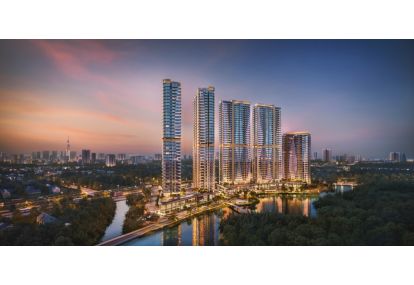
Commercial Housing Policy: 'Today Yes, Tomorrow No'—What a Waste!
Currently, Vietnam's commercial housing policy faces a major paradox: the constant changes in regulations and policies cause enterprises and relevant parties to face a 'today yes, tomorrow no' situation when implementing commercial housing projects. This issue not only creates difficulties for investors but also wastes resources in terms of land, time, and development opportunities.
Constant Changes in Land Policy
For a long time, the transfer of land use rights among economic organizations, enterprises, and citizens has faced significant difficulties. Before 2015, under the Land Law, economic organizations could transfer agricultural land use rights to implement non-agricultural projects in line with planning. However, the 2014 Housing Law stipulated that enterprises could only carry out commercial housing projects on residential land, which caused many projects to stall due to the complex land acquisition process. A piece of land might need to be divided into multiple smaller plots, each belonging to different landowners, and owning 100% residential land was a huge challenge.
This policy led to a complete stagnation of commercial housing projects. Enterprises and local governments repeatedly proposed amendments to allow more flexibility in land use, especially for non-residential land. Although the National Assembly had issued some resolutions, such as Resolution No. 18 in 2022, to allow enterprises to convert land use purposes, by early 2024, under the newly passed Land Law, the old viewpoint was restored, requiring enterprises to transfer only residential land for commercial housing projects.
'Today it's possible, tomorrow it's not' — the consequences of a lack of stability
The constant changes in policy not only delayed projects but also wasted resources. Enterprises face the situation of 'today it's possible, tomorrow it's not' when implementing projects, making it impossible for them to plan long-term strategies. The instability of land policies reduces predictability, leading to less certain investment decisions and making them prone to cancellation when policies change.
This is especially severe in the context where enterprises constantly need to find land for commercial housing projects, particularly in major cities like Hanoi and Ho Chi Minh City, where housing demand is enormous. Project delays and interruptions waste time, resources, and development opportunities for enterprises, while the real estate market still lacks supply.
Wasting opportunities for economic development
A more serious consequence of policy instability is the waste of economic development opportunities. The lack of stable land policies causes social resources—which are crucial for economic development—to remain stagnant. Enterprises cannot implement projects on time, leading to the real estate market failing to meet housing demand and disrupting the development of related economic sectors.
This waste is not limited to enterprises; it also affects the macroeconomy. When policies lack coordination and stability, investors lose confidence, weakening the country's investment and competitive environment. As a result, domestic and foreign enterprises become wary of large projects, fearing policy changes or stagnation, causing social resources to be underutilized.
Infrastructure investment and the PPP model: a similar waste?
We see similar situations in infrastructure investment projects. Policies and investment mechanisms, especially BOT and BT projects, also frequently experience 'today it's possible, tomorrow it's not.' These policy changes or halts force projects to be suspended or alter their investment methods, wasting time and capital, while also causing difficulties for local governments and enterprises. The postponement or even cancellation of infrastructure projects has a significant impact on economic development, reducing the quality of infrastructure connectivity and increasing social costs.
The need for stable, long-term policies
To solve the 'today it's possible, tomorrow it's not' problem, commercial housing policies and related issues need to be designed with a long-term, stable perspective. There needs to be breakthrough changes that facilitate enterprises in accessing land for commercial housing projects without encountering regulatory obstacles, while ensuring transparency and fairness in the process.
Restoring and rebuilding policies in the residential, infrastructure, and land sectors not only resolves current difficulties but also strengthens trust in the legal system, creating a stable investment environment. If policies lack coherence and transparency, social development will be delayed, resources will be wasted, and opportunities will gradually disappear.
In the context of the nation's urgent need to develop all resources to drive growth, improving and stabilizing policies is a top priority. Stable policies will help businesses, investors, and citizens move forward steadily on the path of development, thereby promoting sustainable economic growth in the new era.
#FTT Real Estate Co., Ltd.
(#Real Estate Consulting / #Leasing and Property Management and Sales / #Furniture and Decoration)
LINE official account @ymq0321f|Zalo +886 956 918 888|WeChat
┃Youtube: FTT REAL ESTATE
┃Website : www.fttland.com